How to Become a Textile Designer
Find out how you too can become a successful Textile Designer with these 7 tips!
I've been in the textile industry for the last six years and have designed home decor sold by Anthropologie, Target, Lulu and Georgia. I’m going to teach you seven essential steps to becoming a textile designer. You don’t need a fancy degree or connections to get you started. It’s super simple!
If you prefer, you can watch my Youtube video instead.
WATCH MY YOUTUBE VIDEO
HOW TO BECOME A TEXTILE DESIGNER?
1 | DEVELOP TECHNICAL SKILLS
So, the very first thing that you absolutely need, which might seem pretty obvious, are the technical skills. You can't become a designer unless you know how to use tools like Photoshop, Illustrator, or Inkscape (tip: Inkscape is free if you're not able to afford the monthly payments for Illustrator or Photoshop).

I don’t believe that traditional school is necessary for you to become a textile designer. There’s plenty of tutorials on Skillshare and YouTube that you can learn from. So, make sure to tackle that approach first.

2 | KNOW WHO INSPIRES YOU
This is a big one. Do some research online to see which style you think you’d be best at or which interests you most. Orla Kiely is one site in particular you can browse for inspiration. Also, you need to research retailers like Target, West Elm, Pottery Barn, and at home.
You really need to be able to understand these retailers’ brands so that when you're developing your portfolio, you have something to offer for every type of look. It’s really great to have a range of styles.

Also, you will want to research different design blogs like Design Seeds and Print & Pattern.
Knowing who inspires you is especially important during interviews as most interviews will ask you how you get inspired to do your work. So, you want to be able to answer this question in great detail.
3 | CREATE A BADASS PORTFOLIO
This is the one major thing that you have to do if you want to land a job as a textile designer.
You can be cool as hell, you can get along with everyone, you can have the best outfit, you can feel prepared in every other way… BUT if your portfolio doesn't totally kick ass, you're not going to get the job.
Most textile designers carry around a physical and a digital portfolio.
In the physical portfolio, you'll want to include around 20 designs, and 30 for a digital portfolio.
You want to make sure that in your portfolio you are showcasing a range of different styles. Employers will LOVE to see your versatility.

When you're applying for a textile design job, they're going to be giving you different projects. They're going to be giving you different looks to develop within their line and they may also be giving you different customer projects.
So, you not only need to be able to show in your portfolio that you understand how to develop styles for different brands, but you need to also understand retailer brands and showcase a range of your own style.
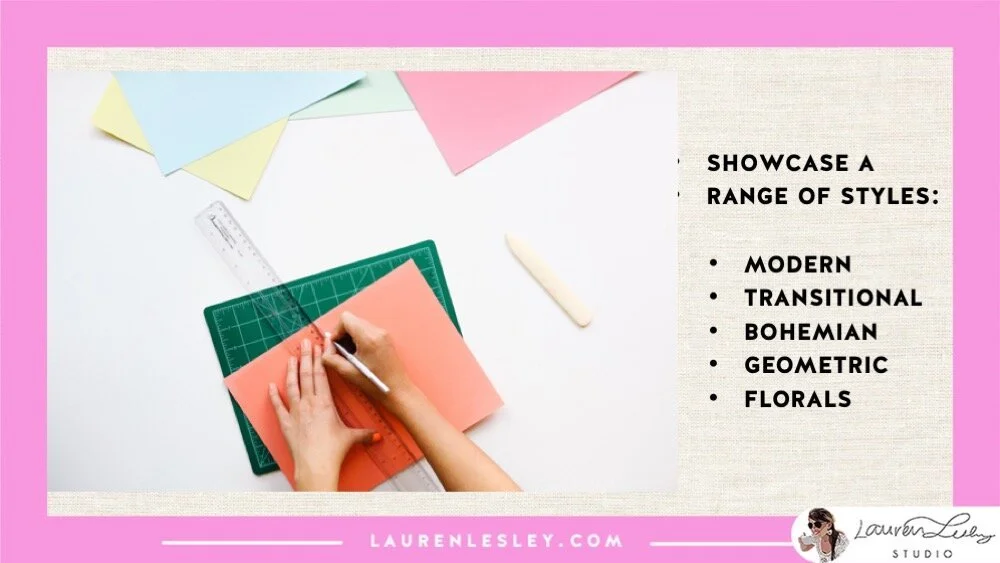
The top 5 styles to include in your portfolio:
Modern
Transitional
Bohemian
Geometric
Florals
This will show your employer that you’re well versed in different styles and can take on different projects.
4 | UNDERSTAND CONSTRUCTIONS
Most employers understand that they are going to teach you about constructions that are more specific to the work that they're doing and the products that they're making.
But, it's still definitely important for you to have a basic understanding of different constructions.
You want to also understand handmade versus machine-made products. If you’re unsure of how to know the difference, research retailers and look at the tags on their products. On the tags it’ll say if it’s handmade or machine-made.
Start developing an eye for that!
You also want to know the different types of weaves, like cotton duck vs. twill. You’ll also want to understand embellishments like beating or metallic prints. You’ll want to understand embroidery, aka different kind of stitching.
Knowing all these things is going to make you look like a superstar textile designer during your interviews!

5 | KNOW YOUR FIBERS
This is probably just as important as understanding constructions.
You’re going to want to know the properties and characteristics of:
Cotton
Wool
Polyester
Polypropylene
Nylon
Olefin
Pet

Knowing these things is only going to be icing on the cake and could really be the defining moment where an employer chooses you over a different candidate.

6 | APPLY FOR JOBS
Apply, apply, apply!
This is so important for many reasons. I believe that any new and aspiring textile designer should land a job with a company before trying to go out on their own or start their own business.
The main reason I recommend this is because you’re going to learn SO much on the job and you’re also going to be paid to learn. If you choose to go to school, yeah you’ll learn there too, but you’ll also be paying the school.
Apply for textile design jobs through LinkedIn, Indeed, or other platforms. Check out networking events in your area too or hire a recruiter. LinkedIn is how I landed my first textile design job!
And let me tell you… I had no background in textiles. I was a studio art major in school and worked for a t-shirt company as a graphic designer before this gig. But, I worked hard on my portfolio and develop the necessary knowledge and skills.
So, don’t be afraid to apply! There’s no risk.

7 | BE WILLING TO MOVE
You have to be open to the idea that sometimes, you might have to move for work. If you’re going to take that first job you’re offered and you know it’s a great opportunity, but it’s in a new place, that’s your green light!
You have to be willing to move in order to follow your dreams. Keep in mind, it doesn’t have to be permanent. If it doesn’t work out, then you can always move back or try out something new.
SKETCHBOOKING YOUR STYLE
By the way, if you’re wanting to get in the Surface Pattern Design / Illustration game, but you are really struggling to develop your own art style, be sure to check out my free workshop.
It includes how to create a system for creating your own, unique Art Style.
Sign up below!